Latest Blog

Why Your Yard Turns Into a Swamp Every Time It Rains

Is your yard still holding water after a storm? Learn what causes yard flooding and which drainage, grading, and erosion solutions can actually fix it...

There’s a spot in the yard that just won’t drain. Sometimes it’s near the driveway. Sometimes it’s right up against the house, which honestly is the one that should get your attention first. Living out here in Hertford, Camden, Currituck, Edenton, and Elizabeth City, we’re used to weather that doesn’t ease in — it just shows up. A few inches of rain in an afternoon isn’t rare for us. And when it hits ground that isn’t graded right, that water has to go somewhere. Usually it’s wherever is least convenient for you.

LITTLE RED TRACTOR

Why Your Yard Turns Into a Swamp Every Time It Rains

So what’s actually causing it?

Most of the time it’s one of these.

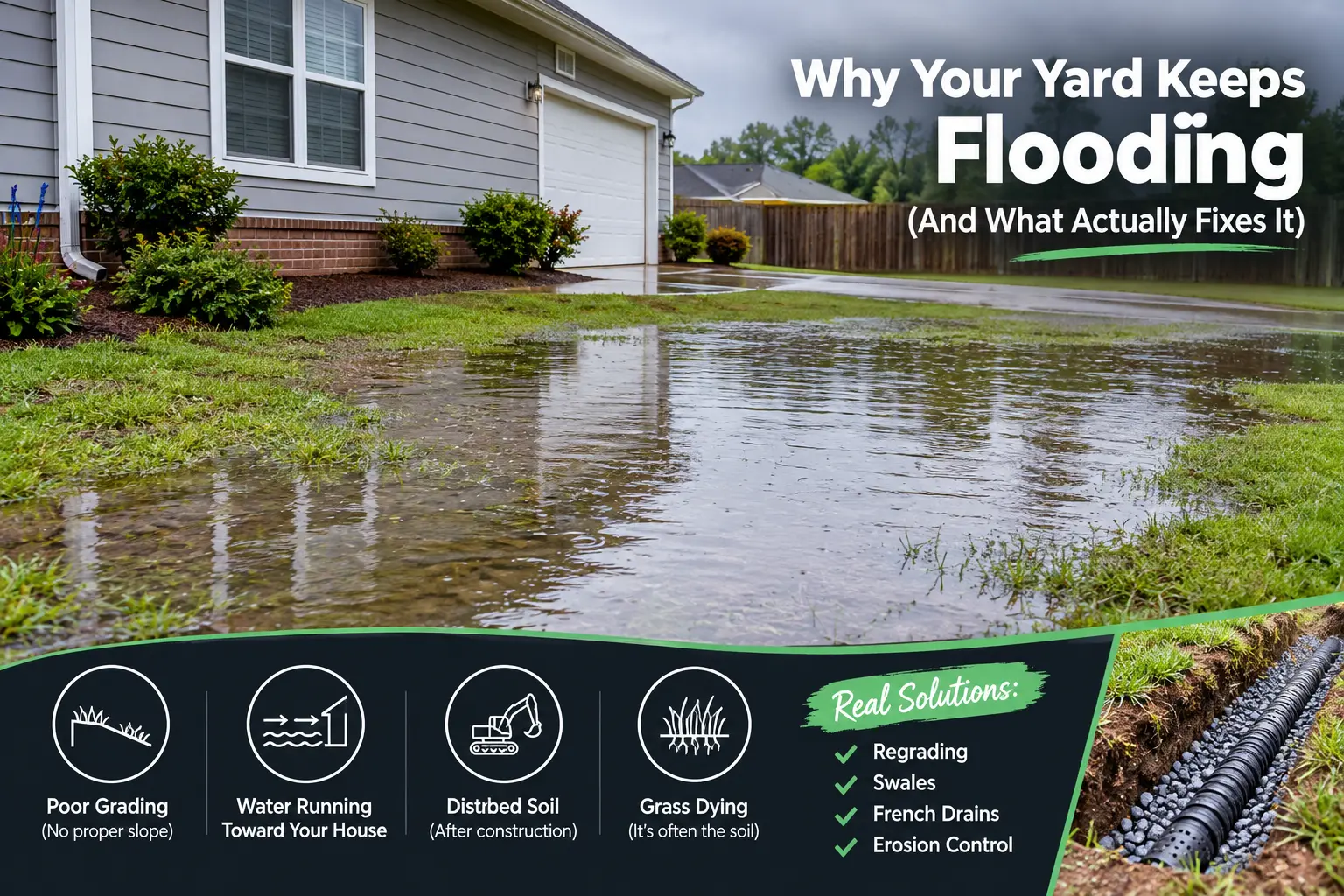
The ground is flatter than it looks. You don’t need much of a slope for water to move, but if there’s none at all — or if it’s worn down over the years from foot traffic, mowing, whatever — water just sits. It’s not dramatic. It’s just enough of a dip to hold water for a day or two after everyone else’s yard has already dried out.

The slope runs the wrong way. This is the one we care about most. If water’s running toward your foundation instead of away from it, that’s not really a yard problem anymore. Give it a few seasons and you’re looking at a wet crawlspace, or worse.

Something got disturbed and never got fixed right. Had a driveway put in? An addition built? Any time equipment moves dirt around, the way water naturally traveled through your yard changes with it. If the erosion or standing water started right after a project like that, that’s usually your answer.

The grass dying isn’t really about the grass. New sod dying in the same patch, seed washing out before it roots — folks usually blame the seed or figure they got a bad batch of sod. [We had one out near Camden last year where the homeowner had reseeded that same strip three times before calling us — turned out the base underneath was compacted from an old shed pad.] Nine times out of ten, it’s what’s underneath, not what’s on top.

What we’d actually recommend

It depends on the property. Usually it’s some combination of regrading so water has somewhere to go, and adding something like a swale or a French drain if there’s a bigger volume of water moving through. Sometimes it’s a smaller fix than people expect walking in. Sometimes it’s not, and we’ll tell you that straight too.

We’ve been doing grading, drainage, and erosion control work across northeastern NC since 2024, and we’d rather walk your property and give it to you honestly than sell you something you don’t need.

Will regrading my yard kill my existing grass or landscaping?

Not necessarily. Depending on the scope, we can often work around established landscaping, or if it’s a full regrade, replant afterward with sod or seed. We’ll walk you through what to expect for your specific yard before any work starts.

How long does a typical drainage or grading project take?

Smaller residential jobs are often done in a day or two. Larger properties or ones needing swales, culverts, or French drains can take longer. We’ll give you a realistic timeline once we’ve seen the site.

Do you serve my area?

We work throughout Hertford, Camden, Currituck, Edenton, Elizabeth City, Moyock, Plymouth, Williamston, and Albemarle Plantation. If you’re nearby and not sure, just give us a call.

Give us a call at (252) 564-2977 or get a free estimate here — costs nothing to ask.

Frequently Asked Questions

Why does my yard flood even though I don't live near water?
You don’t need to be near a creek or river for this to happen. Flat or improperly sloped ground is enough on its own. Rain has to go somewhere, and if your yard doesn’t have a real slope to carry it away, it’ll just sit in the lowest spot until it soaks in or evaporates.
Heavy rain causes puddles everywhere for a few hours. A grading problem shows up as the same spot flooding every time, and it takes noticeably longer to dry out than the rest of the yard. If you can predict where the water’s going to pool before the storm even hits, that’s your answer.
Yes, more than people realize. Water sitting against a foundation over time can lead to crawlspace moisture, mold, and eventually foundation movement. It’s a lot cheaper to fix the grading now than to deal with foundation repair later.

Small, cosmetic puddling you can sometimes handle yourself, adding topsoil, reseeding, that kind of thing. But if water’s pooling near the house, if it’s a large area, or if you’ve already tried reseeding and it keeps failing, that usually means the grade itself is off, and that’s not really a DIY fix. Moving the right amount of dirt at the right slope takes equipment and experience.

It really depends on the size of the area, how much dirt needs to move, and whether drainage features like a swale or French drain are needed too. We don’t like giving a number without seeing the property first, that’s why our estimates are free. It costs nothing to find out.

Clearing Land in Northeastern NC: What I Tell Folks Before We Start

Clearing Land in Northeastern NC: What I Tell Folks Before We Start

Latest Blog Stump Grinding & Site Prep: Don’t Let the Stump Be an Afterthought People call us about clearing for…

Stump Grinding & Site Prep: Don’t Let the Stump Be an Afterthought

Stump Grinding & Site Prep: Don’t Let the Stump Be an Afterthought

Latest Blog Stump Grinding & Site Prep: Don’t Let the Stump Be an Afterthought Most people think the tree is…
Why Your Yard Stays Wet (and What We Do About It)

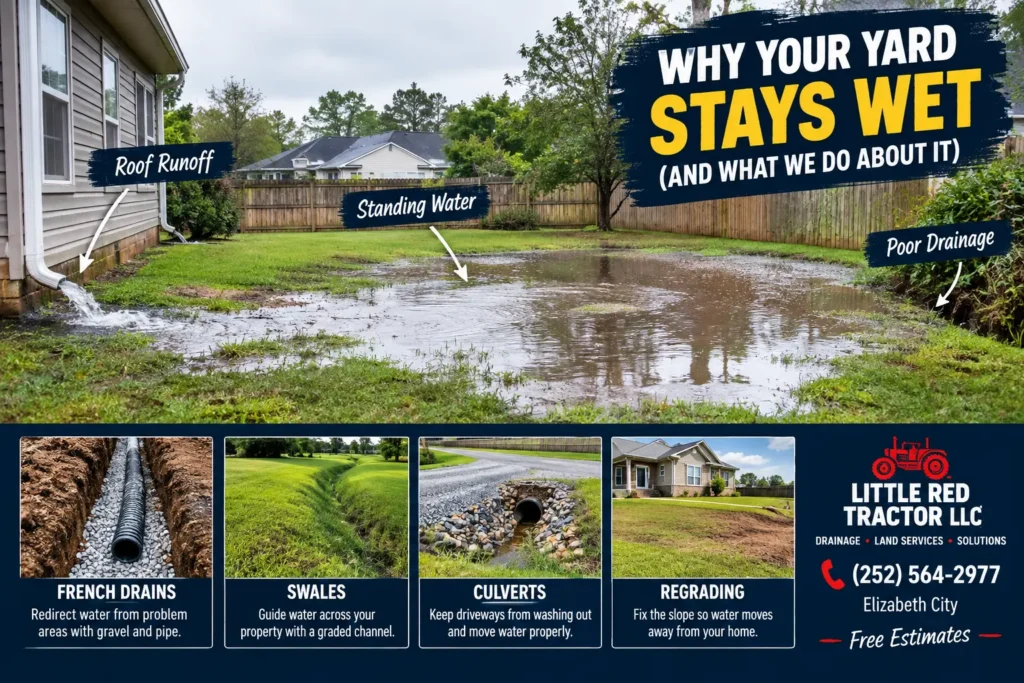
Why Your Yard Stays Wet (and What We Do About It)

Latest Blog Why Your Yard Turns Into a Swamp Every Time It Rains Is your yard still holding water after…

Scroll to Top