Clearing Land in Northeastern NC: What I Tell Folks Before We Start
Latest Blog Stump Grinding & Site Prep: Don’t Let the Stump Be an Afterthought People call us about clearing for…
Is your yard still holding water after a storm? Learn what causes yard flooding and which drainage, grading, and erosion solutions can actually fix it...
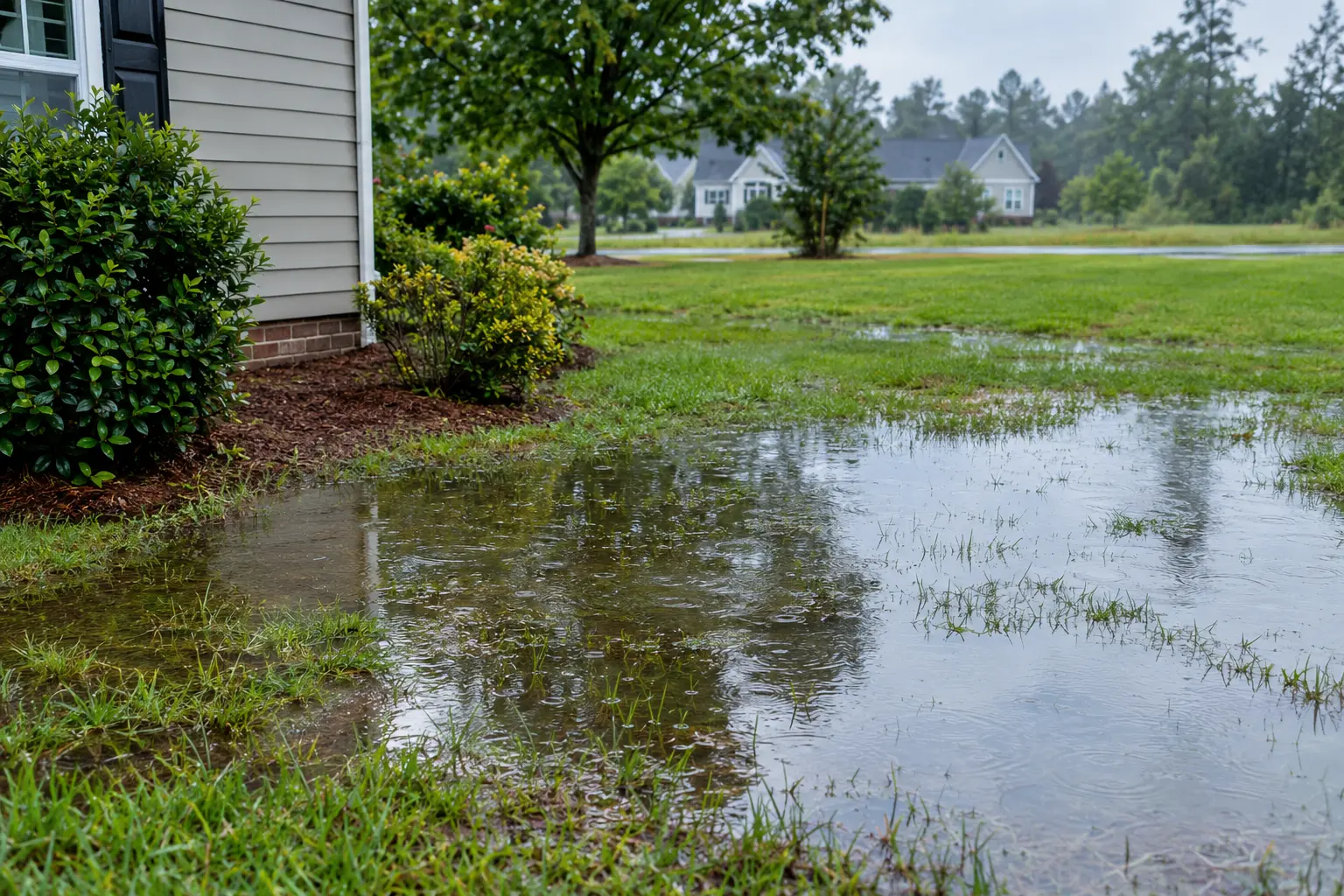
Standing water after a rain is the call we get more than any other. Elizabeth City, Edenton, Currituck, Camden, doesn’t matter. Same story.
Here’s why: clay. Up here the soil is heavy and the particles are so small they pack together with almost no gaps. Water has nowhere to go. Down on the Outer Banks it’s the opposite. Sand, so the rain’s gone in a few minutes. Same storm, a few miles inland, and your yard can stay soggy for days.
Built in the last 10 or 15 years? Then your yard is likely worse off than the land was before the house went up. Builders strip the topsoil, shove clay subsoil back across the lot, and drive heavy equipment over it until it’s packed like a parking lot. NC State Extension covers this, and we see it constantly.
Then fill it again and watch the clock. Still holding water after 12 hours? Your soil isn’t draining right. In this part of the state, that’s a common result.
Shrubs turning yellow and droopy in a wet season is another one. People figure they’re thirsty and water them more. They’re actually drowning.
Almost everyone has tried this before they call us. It makes sense on paper, but a little sand mixed into clay sets up like concrete. You’d need roughly four or five times as much sand as clay for it to help, and nobody’s doing that. Gravel in the bottom of a planting hole is the same kind of mistake. In clay it just makes a bathtub around the roots.
Compost is the cheap fix, and it’s slow.
The clay slowly clumps up and water starts finding its way through. Use compost that’s fully broken down, because fresh material pulls nitrogen out of the soil.
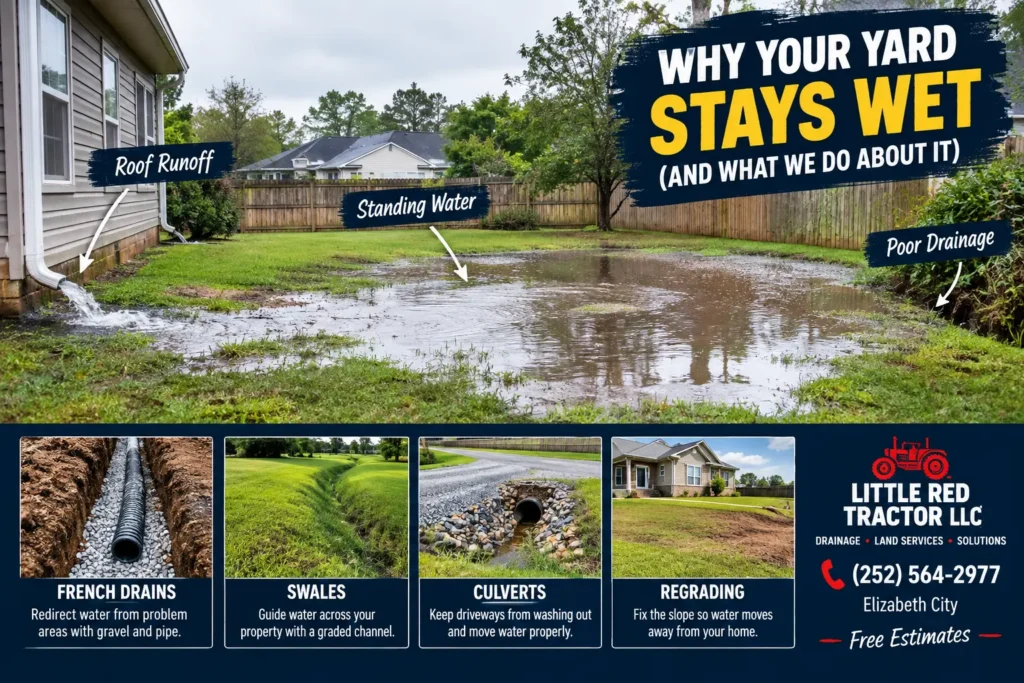
French drains are good for one or two spots that keep flooding. Trench, perforated pipe, gravel, cover it over. Clay can get in the way, though, since water sometimes never reaches the gravel in the first place. When that happens we loosen the soil above it or add a catch basin.
Permeable pavers help if your water mostly comes off a driveway or patio. They work best where traffic is light and the ground is on the sandy side. In pure clay you’ll want an underdrain.
Grading is usually the real answer when the problem is big. And it’s not just moving dirt around.
One legal point. In North Carolina you can’t send your runoff onto a neighbor’s property, so a pipe aimed at the fence line is a problem waiting to happen. And if you’re within about 75 feet of water, CAMA rules may apply and you could need a state permit.
If water’s near your foundation or in the crawlspace, call. Same if the wet area is bigger than a flower bed, you’re on fill dirt in a newer house, you’re close to wetlands, or you’ve tried the easy fixes already.
We work in Elizabeth City, Hertford, Camden, Currituck, Edenton, Moyock, Plymouth, Williamston and Albemarle Plantation. We won’t dig a trench and leave. We look at how the water moves across your property first, then decide.
I’d rather spend twenty minutes looking at your place than guess and have you pay for the same job twice.
The right drainage solution depends on where the water is coming from, how it moves across the property, and where it needs to go.
If you’re dealing with standing water, a wet yard, poor drainage, driveway washout, or water running toward your house, call me at (252) 564-2977 or use the contact page.
Estimates are free.
Jim Caldwell
Little Red Tractor LLC
Elizabeth City
A yard can stay wet when water has nowhere to drain. Flat ground, poor grading, runoff from another property, roof runoff, blocked ditches, and other drainage problems can cause water to collect in the yard.
A swale is a shallow, graded channel that gives water a defined path across a property. It can be useful when water needs to move across a larger area instead of collecting in one spot.
A driveway can wash out when water cannot move properly through a culvert. A culvert may be too small, set too high, or blocked by leaves, mud, and other debris.
Yes. Regrading can change the slope of the property so water moves away from the house instead of toward it. A drain may not solve the problem if the overall grade is directing water in the wrong direction.
Get a free estimate here or give us a call at (252) 564-2977. Doesn’t cost anything to ask.
Latest Blog Stump Grinding & Site Prep: Don’t Let the Stump Be an Afterthought People call us about clearing for…
Latest Blog Stump Grinding & Site Prep: Don’t Let the Stump Be an Afterthought Most people think the tree is…
Latest Blog Why Your Yard Turns Into a Swamp Every Time It Rains Is your yard still holding water after…